Carignan Red Wine Variety
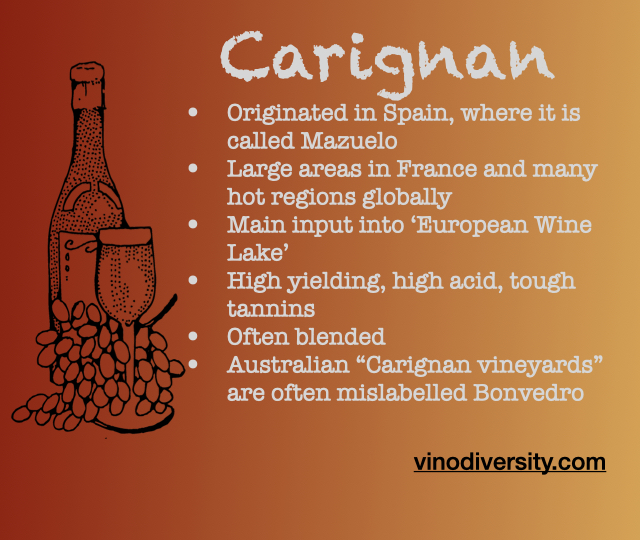
Carignan is the variety most responsible for the fabled 'European Wine Lake'.
It's modern home is the South of France, particularly the Midi, but it seems likely the variety may have originated in the Spanish province of Aragon.
This Spanish origin gives priority to the variety's Spanish name Mazuelo.
Carignan's Roller coaster
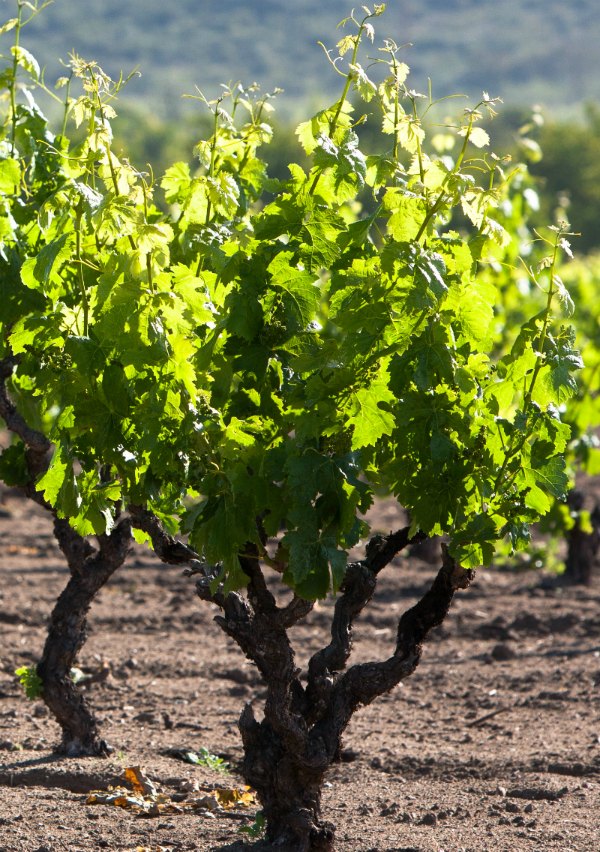
Jancis Robinson was once a severe critic of Carignan, and rightly so. The variety was used (misused) to make huge volumes of vin ordinare
But is it the fault of the variety, or of the way it is used? Growers and winemakers saw its characteristics as virtues in making cheap wine, and there was a big market in France for cheap wine back then.
The official name in Spain is Mazuelo, but it is also called Carinena. It is not widely grown in Spain, even though that is where the variety originated.
As Carignano, this variety plays an important role in Sardinia where it is the second most planted red grape after Cannanou (Grenache).
There are small plantings in most warmer wine producing counties, but it is no where a dominant variety.
jancis Robinson's take on Carignan

Carignan wines are now in retreat but some winemakers headed by John Bojanowski of Clos du Gravillas wines in St. Jean de Minervois, Languedoc have started the Carignan Renaissance.
See their website for activities and events.
They hope to reverse the trend of ripping out Carignan and replacing it with the ubiquitous Merlot. More strength to their arm I say!
Carignan Renaissance have managed to convince Jancis that it is possible to make decent wine from this variety.
Carignan In Australia
Carignan was once much more popular in Australia. It seems to have had an unacknowledged role in some of the wine we once called claret, often blended with such varieties as Shiraz, Grenache, Cinsaut and Mourvedre.
I guess a lot of it found its way into flagons and casks as well.
Little of it seems to have survived the vine pulls of the 1980s when there was a glut of ordinary red wine in Australia.
Over recent years it has been established that much of the 'Carignan' in Australia is actually another variety called Bonvedro or Parraleta. Most of the 'Carignan' vines in Australia before the 1960s and other vineyards that have had propagated from them are actually Bonvedra.
Later imports of Carignan from California and vineyards derived from them are in fact Carignan. Thanks to Dr Peter Dry of the Australian Wine Research Institute for clarifying this issue for me.
In the list below some of the wineries may have Bonvedro but they still use the name Carignan.
Australian Wineries with Carignan
- 919 Wines Riverland
- Amato Vino Margaret River
- Angoves Winery Riverland
- Bleasdale Langhorne Creek
- Brash Higgins McLaren Vale
- Charles Melton Barossa Valley
- Claymore Clare Valley
- Dr Plonk McLaren Vale
- Dune McLaren Vale
- Elderton Barossa Valley
- Forage Supply Co Barossa Valley
- Geddes Wines McLaren Vale
- Happs Margaret River
- Head Wines Barossa Valley
- Hewitson Barossa Valley
- Hither and Yon McLaren Vale
- Kabminye Wines Barossa Valley
- Kimbolton Langhorne Creek
- La Madrina McLaren Vale
- Mansfield Wines Mudgee
- Ministry of Clouds McLaren Vale
- Mirus Barossa Valley
- Payton and Jones Yarra Valley
- Samuels Gorge McLaren Vale
- Seldom In McLaren Vale
- Seppeltsfield Barossa Valley
- Shobbrook Wines Barossa Valley
- Small Victories WIne Barossa valley
- Smallfry Wines Barossa Valley
- Soul Growers Barossa Valley
- St Ignatius Vineyard Pyrenees
- Tellurian Heathcote
- Tomfoolery Barossa Valley
- Way Wood Wines McLaren Vale

This variety is one of the 190 grown in Australia. They are featured in the new book Beyond Shiraz. The book is available in Kindle format (for your phone) or as a paperback
You might like these
Petit verdot red wine variety
Petit verdot red wine variety from Bordeuax usually blended but also makes varietal wine. See Aussie producers
Tannat Red Wine Variety
Tannat Red Wine Variety, description, health benefits and producers in Australia
Touriga Nacional Wine Variety in Australia
Touriga Nacional Wine Variety in Australia, description and producers


Carignan and food
Carignan wines are often characterised by high acidity and tannins, hence they call for richly flavoured, rustic dishes.
Toulouse sausages, cassoulet, Morrocan lamb tagine or grilled pork chops might go well with Carignan dry red wine.
Evan Goldstein in Daring Pairings claims there is an affinity between sweet fortified wines and chocolate (especially dark chocolate) based desserts.

Subscribers to Vinodiversity Community get invites to Darby's Special Taste and Talk Sessions.
Search

Recent Articles


-
Petit verdot red wine variety
Apr 19, 26 01:20 AM
 Petit verdot red wine variety from Bordeuax usually blended but also makes varietal wine. See Aussie producers
 -
Alternative Varietal Sparkling Wine
Apr 06, 26 01:19 AM
 Do you enjoy sparkling wine? Try these from non traditional varieties
 -
Tannat Red Wine Variety
Apr 05, 26 08:54 PM
 Tannat Red Wine Variety, description, health benefits and producers in Australia
 -
Alternative Variety Chooser
Mar 16, 26 07:18 PM
 A simple app to choose an alternative variety
 -
Buy Beyond Shiraz
Mar 15, 26 06:49 PM
 Beyond Shiraz: Your Passport to the Future of Australian Wine
 -
Inzolia Wine Variety
Mar 09, 26 09:22 PM
 Inzolia or Ansonica is an Italy White wine variety now used in Australia


My new Book



Our Site Sponsors
 Cargo Road Wines in the Orange NSW region is a Site Sponsor of Vinodiversity
 Hahndorf Hill Winery in the Adelaide Hills is a Site Sponsor of Vinodiversity
 Frankly This Wine is made by Bob
 Order this book about Rare Aussie wines
 This book describes the most important wines globally
 Savina Road in the Granite Belt Region is a Site Sponsor of Vinodiversity
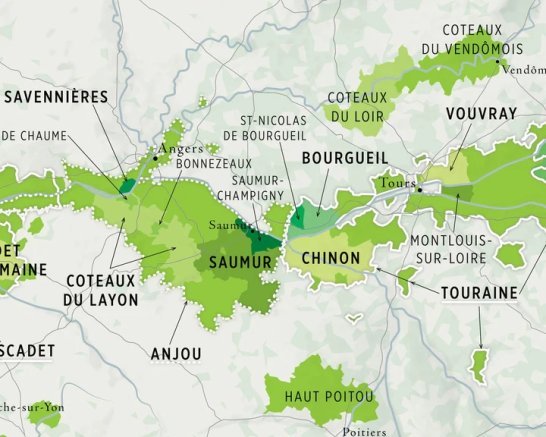 Detail of the new map of France. Italy and Spain also available
Become a Site sponsor
You can use this space to promote your winery or wine based business.
See this page for details
Contact Darby for details.